

Why Business Coaching Fails: 9 Common Mistakes New Zealand Business Owners Make (And How to Fix Them)
Here's what nobody tells you when you sign up for business coaching: the programme is rarely the problem.
Most NZ business owners who've tried coaching and walked away with nothing to show for it didn't fail because they picked a dud coach. They failed because they showed up the wrong way, with the wrong expectations, or without being fully honest about what was actually going on in their business.
That's harder to sit with than "my coach wasn't good enough." But it's also more useful, because it means the outcome was always partly in your hands. Business coaching only works as well as the person in it.
This article is written for the businessman or business owner who either hasn’t yet tried coaching and needs some help figuring out how to choose an effective coach or one that is trying to learn how to coach effectively. The truth behind why business coaching doesn’t work and what makes successful ones will be explored.
What Is Business Coaching and How Does It Work?
Firstly, a business coach should not be confused with a consultant. They don't just come to give you some document with a strategic plan and then vanish. They are there to work with you personally, most of the time, through weekly or fortnightly coaching sessions, and help you make smart decisions, be more deliberate, and create the clarity, which is often not easy to achieve from the inside.
The procedure in itself can always be structured the same way: weekly or fortnightly meetings, predefined goals for each meeting, accountability between sessions, and feedback to track your progress. The thing is, however, that an effective coach must challenge your assumptions, recognize certain patterns for you, and even say some unpleasant things sometimes.
In New Zealand, the quality gap between coaches is wide. Some are genuinely excellent. Others are not. Good business coaching changes how you operate. Poor business coaching changes nothing except your bank balance. The results almost never come from the sessions themselves. They come from what you do between them.
9 Common Mistakes New Zealand Business Owners Make
Nine reasons. Most you'll recognise, either from your own experience or from watching someone else go through it.
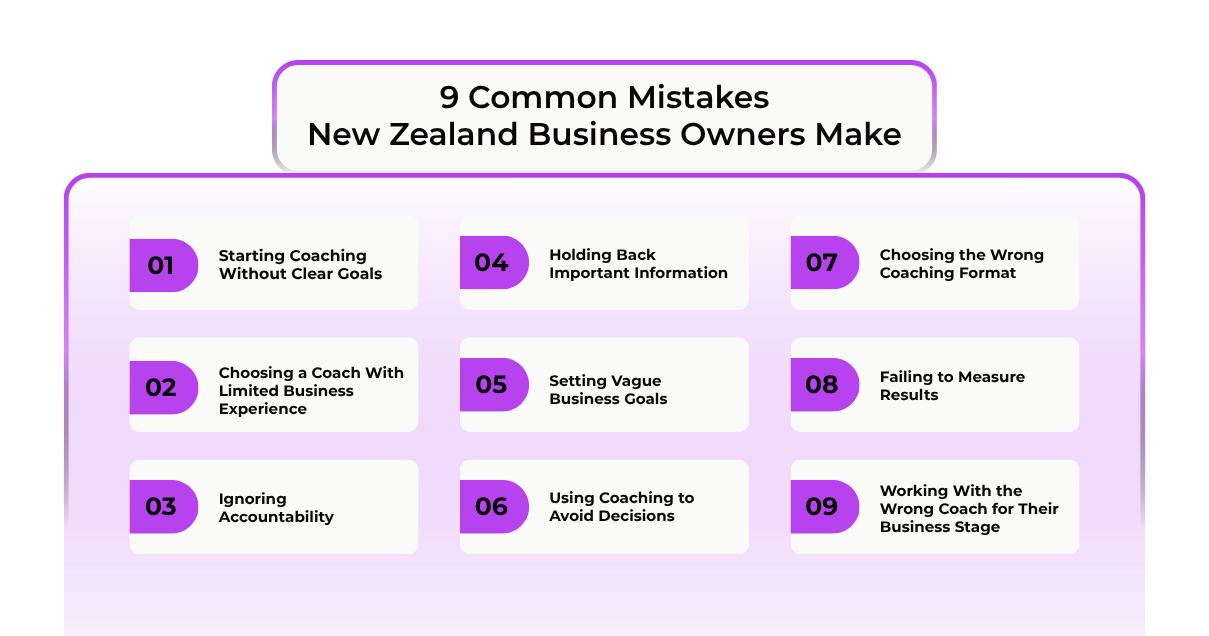
1. You Hired a Coach Without Knowing What You Actually Needed
A lot of business owners hear a recommendation from a friend, see someone else getting coaching, or simply feel stuck and decide it's time to bring in a coach. The problem is they often can't clearly explain what they're trying to fix.
Coaching works best when there's a specific goal behind it. Otherwise, it can turn into a series of conversations that don't lead anywhere. Before hiring anyone, ask yourself this: if one thing improved in your business over the next six months, what would have the biggest impact? Start there.
2. The Coach Had No Real Business Experience
Knowing how to ask good questions isn't the same as understanding how businesses actually work. When a coach lacks operational grounding, sessions tend to float at a level that feels thoughtful but produces nothing concrete. You need someone who gets the reality of running a business, not just the psychology of leading one.
3. Nobody Actually Enforced the Accountability
Great session, clear commitments, busy week, nothing done, next session arrives, coach doesn't push too hard, everyone moves on. This pattern repeats endlessly.
Accountability in business coaching isn't optional. It's the mechanism that makes the whole thing work. If your coach isn't having a direct conversation when you consistently don't follow through, the relationship drifts into something comfortable and useless.
4. You Weren't Fully Honest in the Room
Most business owners are not entirely truthful. Most of them tend to make alterations to their financial status, ignore team conflicts, or make decisions that make them seem more in control than they actually are.
An executive coach is limited by your disclosure. If the picture they're seeing is polished, the advice and questions they give back will be off. The coaching relationship is confidential. Nothing leaves that room. If there's anywhere to be completely straight about what's going on in your business, it's there.
5. The Goals Were Too Vague to Be Useful
"I want to grow my business" tells a coach almost nothing. What does growth mean? Revenue? Team size? Your own time back? By how much, by when?
Vague goals produce vague outcomes because there's nothing concrete to navigate toward. After six months you're trying to describe what changed, which usually amounts to "I think about things differently now." That's not nothing, but it's not what you paid for.
6. Coaching Became a Substitute for Making Decisions
Some business owners, if they're honest, use coaching as a way to feel like they're dealing with a problem without actually dealing with it. They discuss the same issue across multiple sessions, generate a lot of insight about why it exists, and never quite get around to acting.
A good coach spots this and names it. If you've been discussing the same problem for three months with no action taken, something needs to shift.
7. The Format Didn't Fit How You Work
Some people benefit from weekly sessions because the frequency keeps them focused. Others find fortnightly works better because it gives them time to implement before they come back. Same with group versus one-on-one. Group programmes are valuable for peer learning and cost, but if your situation is complex and specific, a group won't give you the depth of focus you need.
8. Progress Was Never Measured
How do you know if the coaching is successful? This question must have a clear-cut answer; for instance, revenues are increasing, you have solved some issue in the team, you work less since the way the company works has changed. If the honest answer to this question is just that "I am feeling more confident," it deserves being investigated.
9. The Coach Wasn't Right for Where You Are
A coach who's brilliant with early-stage founders isn't necessarily right for someone thinking about exit after fifteen years. Stage of business, industry context, and the nature of the problems you're actually dealing with all matter. In New Zealand, where a lot of coaches operate across multiple industries, it's easy to end up with someone competent but not quite right for your situation.
Signs Your Business Coaching Programme Is Not Working
You leave sessions without knowing what you're going to do before the next one. If there's no clear action, the session hasn't done its job.
You're having the same conversations repeatedly. Some revisiting is normal. Three months of circular discussion with no movement is not.
Nothing in the business has actually changed. Not the revenue, not the team, not how you're spending your time.
You find yourself managing the impression you give your coach. If you're filtering what you share because of how you expect them to respond, the relationship isn't working.
Sessions feel like a chore rather than something with genuine value. Something is off, whether that's the format, the relationship, or the focus.
How to Get Better Results From Business Coaching
Tell your coach what isn't working. Most people avoid this. A good coach will welcome the conversation and adjust. If they get defensive, that's useful information.
Get specific about what you're trying to achieve. Sharpen up the original goals and make sure every session is connected to moving toward something real.
Stop being so polished in the room. Bring the messy stuff. The decision you're avoiding, the team situation that keeps getting worse, the number you're embarrassed to say out loud. That's exactly what the space is for.
Check in on actual outcomes every month or so. Not vibes. What has changed in the business? If you can't name it, raise it with your coach.
Business Coaching vs Business Advisory Services
Business coaching is primarily about you. How you think, how you make decisions, how you lead, what patterns are getting in your way. A good coach makes you a more effective business owner and the business improves as a result.
Business advisory is about the business. An advisor brings expertise in a specific domain, looks at your situation, and gives you their best thinking on what to do. They're not asking what you think. They're telling you what they think.
Both are useful. They serve different purposes. The mistake is expecting your coach to also be your advisor, or assuming your advisor is doing the coaching work. The question to ask yourself is: what do I actually need right now, and from whom?
What New Zealand Business Owners Should Look for in a Business Coach
They should have run something, or worked closely enough alongside people who have, that they genuinely understand what the experience is like. Theory-only coaches exist and can be fine for some things, but when you're dealing with real operational pressure, you want someone who gets it from the inside.
They should explain exactly how they work. Not a vague philosophy. Specifically: how do we set goals, how do we track progress, what happens when I don't follow through. If a coach can't answer those questions clearly upfront, keep looking.
They should be willing to refer you on. If you ask about something outside their expertise and they try to cover it rather than pointing you toward someone better placed, that's a problem.
You need to be able to be genuinely honest with them. Not just comfortable. If there's something about the dynamic that makes you want to present a good version of yourself rather than a real one, the coaching won't go deep enough to be useful.
Ask for references and call them. Ask specifically what changed in their business. The answer will tell you a lot.
Real Business Challenges That Business Coaching Can Help Solve
Delegation. A lot of New Zealand business owners have built something real but can't let go of the doing. A good coach won't just tell you to delegate more. They'll help you understand the specific belief that's making it hard, and work with you on actually changing it.
Stalled revenue. Plenty of businesses in New Zealand grew well early and then stopped. Usually the problem isn't the market. It's that the owner is still running the business the same way they did when it was half the size.
Underperforming teams. This tends to come back to leadership more often than people want to admit. Business coaching helps owners develop the ability to have direct, useful conversations with people rather than avoiding conflict until something breaks.
Burnout. If you're at a point where every decision feels heavy and the energy isn't there, that's something business coaching can genuinely help with, not by telling you to take a holiday, but by helping you restructure how you're working and where your attention is going.
Big transitions. Whether you're building toward exit, bringing on a partner, or shifting from being the operator to being the owner, these changes benefit enormously from someone who can see the bigger picture when you're too close to it.
How Bizdom Helps New Zealand Businesses Achieve Sustainable Growth
Bizdom works with New Zealand business owners who are serious about building something that lasts. The people you're working with have dealt with the actual problems you're dealing with, in businesses that look like yours. That experience makes a difference in how useful the conversations are.
Business coaching at Bizdom is combined with practical advisory support, which matters because the best coaching conversations in the world don't help if you also need someone to look at your numbers and tell you what's actually going on. Both sides of that conversation exist in the same engagement.
In case you have tried coaching before and failed or have been undecided whether coaching can be a good fit for your circumstances, it could do some good to give it a go and see how things pan out. The first meeting will be purely exploratory in nature.
Frequently Asked Questions
-
For some businesses, absolutely. For others, it's a waste of money. It really comes down to whether you're prepared to act on what comes out of the sessions. I've seen owners invest in coaching and change nothing. I've also seen people make one adjustment that paid for the coaching many times over.
-
There's no standard price. Some coaches charge a few hundred dollars a month. Others charge several thousand. What matters more is understanding what you're getting. A cheaper coach who actually helps you solve problems is better value than an expensive one who just gives you motivation for an hour every fortnight.
-
Operational changes can show up within the first couple of months if the work is focused. Deeper shifts in how you lead or how the business is structured tend to take six to twelve months. If nothing tangible has shifted after three or four months, that's worth raising directly rather than waiting it out.
-
A business coach works on you as a leader: how you think, decide, and act. A business advisor works on the business, brings specific expertise, and tells you what they think you should do. Both have real value. The difference is in where the work happens. The best support for many NZ business owners involves both, just not always from the same person at the same time.
-
Start by being honest about what you actually need. Look for someone with experience at your stage and in your type of business. Ask them to explain their methodology in plain terms. Call a few references and ask what actually changed in their business. And pay attention in the first conversation to how honest you feel you can be. If you're already managing the impression you give in the introductory call, it won't get where it needs to go.