

Business Advisory Services in New Zealand: A Complete Guide for Growing Businesses
Most NZ business owners will admit, if you get them talking honestly, that they spend most of their time working in the business rather than on it. The result? Decisions made on gut feel, cash flow surprises that should not have been surprises, and a strategy that lives in someone's head rather than on paper.
That is the gap that business advisory services fill. And for businesses that take it seriously, the difference is significant.
Understanding Business Advisory Services
In general, a business advisor is somebody who collaborates with you on enhancing the overall performance of your business. Of course, it goes without saying that numbers play a critical role in the equation. However, business advisory services encompass much more than that, such as your strategies, operational processes, workforce, cash flows, and objectives.
Over the past ten years, there has been considerable growth in the provision of business advisory services NZ. Nowadays, NZ Business Advisors are not perceived merely as an instrument that major corporations rely on. Instead, small and medium enterprises seek professional advice since the market environment becomes increasingly competitive and more costly to be mistaken in.
The most significant difference between advisors and consultants is in their relationship with clients. A consultant typically arrives, prepares a report, and leaves. A business advisor keeps working with you. Moreover, they regularly monitor the progress, ensure that you meet your commitments, and revise the plan if necessary.
What Do Business Advisory Services Include?
This varies depending on the provider and what your business needs, but most business advisory and consulting engagements cover some combination of the following:
Financial analysis goes beyond your standard P&L. It looks at margins, cost structures, pricing, and where the money is actually going.
Strategic planning means building a proper roadmap for where the business needs to be in two or three years, and what needs to change to get there.
Cash flow management is one of the most common areas NZ businesses need help with. Forecasting, identifying gaps before they hit, and building systems to manage the ups and downs.
Performance reviews are regular check-ins on key metrics, a consistent health check for the business.
Succession and exit planning is something most owners leave too late. A good advisor builds this into the strategy well before it becomes urgent.
Risk management covers the things that could seriously hurt the business and making sure plans exist before those things happen.
Types of Business Advisory Services
Not all advisory work looks the same. Here are the main types you will come across:

Strategic advisory focuses on direction. Long-term positioning, growth strategy, market entry, and competitive advantage.
Financial advisory digs into the numbers. This is where business advisory overlaps most with accounting, but goes further into forward-looking financial decisions.
Operational advisory looks at how the business runs day to day. Systems, processes, team structure, and removing bottlenecks.
People and HR advisory covers workforce planning, culture, leadership, and organisational design.
Sales and marketing advisory is about growing revenue in a sustainable way. Not just more activity, but a proper commercial strategy.
Technology advisory helps businesses modernise, whether that is choosing the right software or thinking through a broader digital strategy.
The right mix depends on where your business is and what is holding it back.
Why Business Advisory Services Are Crucial for NZ Businesses
New Zealand is a genuinely good place to build a business. But it has real constraints. The domestic market is small, finding skilled people is hard in many regions, and access to growth capital can be limited for businesses that have not built strong financial track records.
On top of that, most NZ business owners are doing a lot themselves. They include the owner, the manager, at times even the salesman, and the bookkeeper as well. Making time for clear thinking on a broad scale is certainly not easy when there are daily pressures.
The consultant of New Zealand provides two key ingredients which cannot be readily generated inside; firstly, an outside perspective of a person who is not emotionally tied to the current system, and secondly, a system that can analyze their performance, make forecasts, and help them make decisions using facts.
Companies who interact with advisors have always shown better results than companies which do not interact with any form of advisor.
Key Benefits of Business Advisory Services
Here is what good advisory support actually delivers:
Sharper decision-making. Having someone experienced to stress-test your thinking before you commit is genuinely valuable. Bad decisions are expensive.
Better financial performance. Advisory work almost always surfaces opportunities to improve margins, cut waste, or price more effectively.
Real accountability. When you commit to actions with someone who will follow up, things get done. Underrated, but one of the most consistent benefits.
Reduced risk. A good advisor has seen what goes wrong when businesses scale too fast, take on bad debt, or ignore cash flow. You do not have to repeat those mistakes.
Confidence. Running a business is stressful. Having someone genuinely in your corner makes a real difference to how you operate day to day.
Seven Ways Business Advisory Services Improve Profit and Performance
These are the seven areas where advisory support tends to move the needle most noticeably.
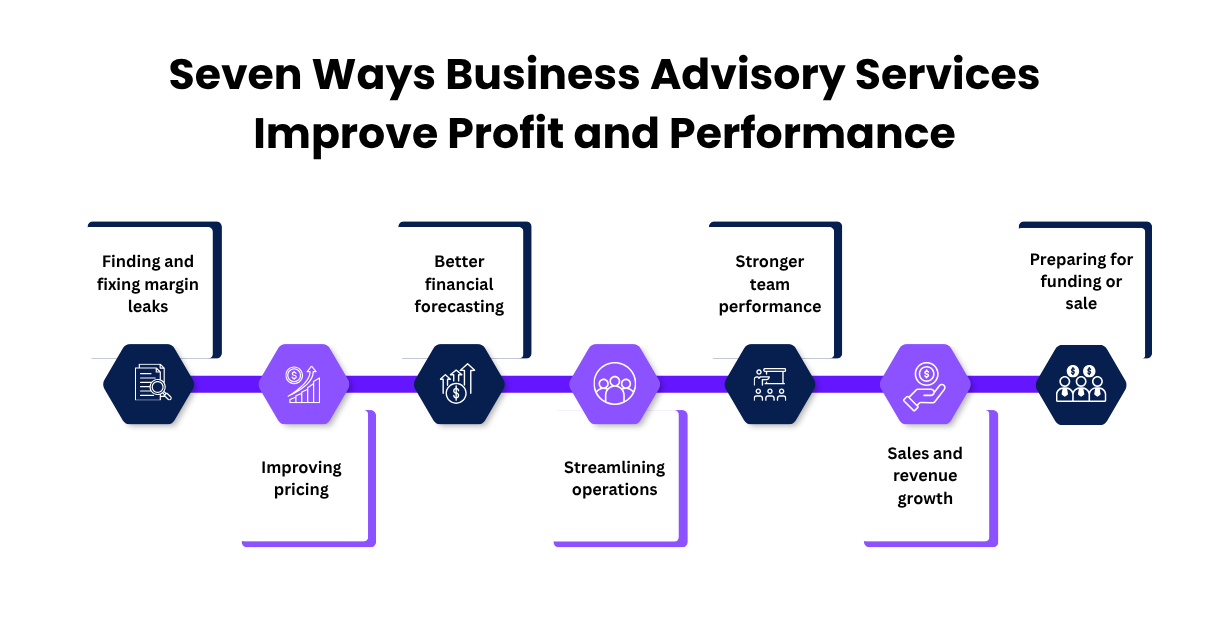
1. Finding and fixing margin leaks. Businesses lose money in ways that are hard to see from the inside. Wrong pricing, a service line that costs more to deliver than it earns, overhead that crept up quietly. An advisor finds these things.
2. Improving pricing. Underpricing is extremely common in NZ. Advisors help business owners understand what things actually cost to deliver and build the confidence to charge accordingly.
3. Better financial forecasting. When you have solid cash flow projections, you stop being surprised. You can plan investment, manage debt, and make decisions from a position of clarity rather than anxiety.
4. Streamlining operations. Time and money wasted on inefficient processes never shows up cleanly on a P&L, but it is real. Operational improvements often deliver outsized returns.
5. Stronger team performance. People issues have financial consequences. Poor structure, unclear roles, and weak culture all affect productivity and retention.
6. Sales and revenue growth. This is about building a commercial approach that converts better and retains customers longer, not just spending more on marketing.
7. Preparing for funding or sale. If you want to borrow, bring in investors, or eventually sell, your business needs to look its best. Advisors help you get there.
How Business Advisory Services Help Small Businesses Grow
There is an abundance of small businesses within NZ's business sector, and arguably, these types of enterprises will benefit from good advice the most.
What poses the greatest problem to small businesses is not a lack of vision. It is a lack of organization. Poor record keeping, lack of clarity with regards to their objectives, goals, and vision, these things might indicate nothing other than poor management on the business's part. However, they serve as a ceiling.
The function of advisory services is to shatter that ceiling. This is done through proper analysis of figures, setting up specific objectives, and establishing ways to achieve those objectives as well as consistently monitoring progress towards them.
They can also help small businesses transform themselves from being personally owned to being scalable in essence. Small businesses will often fail to accomplish this because there is simply too much at stake, which means that external help is required in order to reach that goal.
Business Advisory Services in Hawke's Bay and Napier: Why Local Matters
There is a real difference between working with someone who knows your region and someone who does not.
Hawke's Bay has a distinct economy. Primary sector, food and beverage, hospitality, and a solid base of trade and professional services. The region has its own labour market pressures, its own funding landscape, and its own business community.
A local advisor understands these things because they work here. They know the regional banks, the key players, and what the economic conditions mean for a business operating in the Bay. That contextual knowledge is hard to replicate from a distance.
Accessibility matters too. Face-to-face conversations are different from video calls, and regular in-person contact tends to produce more productive advisory relationships.
Key Skills Every Business Advisor Should Have
Not every advisor is the right advisor. Here are the business advisor skills that genuinely matter:
Financial literacy. Non-negotiable. If they cannot read and interpret your financial statements, they cannot give you useful financial guidance.
Strategic thinking. The ability to connect what is happening now to what it means for the future, and build a coherent path between the two.
Commercial experience. There is no substitute for having worked with real businesses through real challenges.
Communication. The best advisors explain complex things simply, listen more than they talk, and deliver honest feedback even when it is uncomfortable.
Accountability. Good advisors follow through and care about outcomes, not just turning up to a monthly meeting.
Emotional intelligence. Business decisions involve people. A skilled advisor knows how to navigate that with care.
When evaluating an independent business advisor, ask how they work, what outcomes they have helped achieve, and for references from clients in similar situations.
Business Advisory Services vs Accounting: What's the Difference?
This confusion comes up often, so it is worth settling clearly.
An accountant's job is primarily compliance. Financial statements, tax returns, regulatory obligations. Essential work, but mostly backward-looking. It tells you what happened.
A business advisor uses what happened to help you decide what to do next.
An accountant business advisor combines both. Many NZ accounting firms now offer advisory services alongside compliance work, which can be highly efficient since the advisor already has intimate knowledge of your numbers.
That said, some of the best independent business advisors come from operations or commercial leadership backgrounds. Their value is in strategic and operational guidance, not just the financials.
Ideally, you have both: a solid accountant keeping compliance in order, and an advisor helping you make the most of what the business can do.
Making a Strong Strategy Using Business Advisory Services
Strategy is only as good as the execution behind it. Advisory services help with both.
A proper strategy starts with an honest read of where the business actually is right now. Not where you hope it is. What are the real numbers? What are the genuine strengths and weaknesses?
From there, a business advisor helps you define where you want to go and builds the path between the two. What needs to change? What resources are required? What risks need managing? How will you measure progress?
Execution is where most strategies fail. An advisor keeps it alive through regular check-ins, clear accountability for milestones, and honest conversations when things are not going to plan.
How to Choose the Right Business Advisory Services in NZ
There are plenty of options in the market. Here is how to choose well.
Get clear on what you need first. Is it financial performance? Growth planning? A specific challenge? Knowing your priorities helps you assess fit properly.
Look for relevant experience. Has this advisor worked with businesses at a similar stage? Ask for examples and ask about outcomes, not just process.
Trust the relationship test. You will share a lot with this person. If you do not feel comfortable being honest with them after the first couple of conversations, that matters.
Understand their process. Good advisors have a clear way of working. If they cannot explain it simply, that is a warning sign.
Think long-term. The best advisory relationships build value over time. Look for someone you could work with for years, not just a few months.
Why Choose Bizdom for Business Advisory Services in New Zealand?
Bizdom is a Hawke's Bay business that assists New Zealand business owners to do things well, think ahead, and expand confidently.
The difference between Bizdom and others is that their expertise is based on deep financial expertise and actual experience. This means that Bizdom has been there and experienced everything from the inside.
The importance of the local presence in case of businesses in Hawke's Bay and Napier can not be underestimated. Bizdom knows the region and knows what's going on in the business world here.
If you are looking to create a solid structure for your company, manage change, or just want to make your business stronger and be sure about your future, Bizdom will provide all the necessary consulting.
Conclusion
Business advisory services are one of the few investments that tend to pay for themselves many times over when you get the relationship right. Outside perspective, financial expertise, and genuine accountability are hard to replicate any other way.
For NZ businesses, the question is rarely whether advisory support would help. It almost always would. The real question is finding the right advisor and committing to the process.
The businesses that build lasting value make better decisions, consistently, over time. Good advisory support is a significant part of how that happens.
Frequently Asked Questions
-
By identifying where money is being lost, improving pricing, tightening cost structures, and building proper cash flow forecasting. Better margins and better visibility over cash tend to have a real and fairly quick impact on overall business health.
-
An accountant focuses on compliance: tax, financial statements, regulatory obligations. A business advisor uses that financial information to help you make better decisions going forward. Many accountants now offer advisory services as well, combining both in one relationship.
-
Before a crisis is always better than during one. Common triggers include planning for growth, navigating a major change, struggling with profitability, preparing for funding or a sale, or wanting to move from running a good business to a great one.
-
Focus on relevant experience, the quality of the relationship, and a clear process. Ask for references and understand what outcomes they have delivered for similar businesses. Take a long view, the best advisory relationships build value over time.
-
Yes, genuinely. Small businesses often see the most immediate impact because the gaps are clearest and the wins most tangible. Better financial understanding, a proper plan, and consistent accountability make a real difference even at an early stage.