

Is Hiring a Business Consultant Worth the Investment?
Most owners bring in a business consultant at exactly the wrong moment. Revenue's dipped, someone key just quit, or the growth plan that looked great on paper has gone nowhere fast. That's usually when the idea surfaces, as a last resort rather than a real strategy. And that's precisely why so many people walk away unimpressed. A good business consultant earns their fee long before things fall apart, not during the scramble to fix them.
But now let’s go ahead and answer the question. Is it worth the investment to hire a business consultant? Yes, but on one condition. Hire the wrong person, at the wrong time, for the wrong purpose, and you’ve simply paid to have your hunch confirmed. Hire them correctly, and the payoff is considerable. Here’s how to make sure you’re hiring the right consultant.
What a Business Consultant Actually Does
Forget the whiteboard-and-buzzwords image for a second. A business consultant's job comes down to something fairly unglamorous: they find what's actually broken, build a plan to fix it, and stay involved long enough to make sure the fix sticks.
Most owners assume they need help with strategy. Honestly? Strategy is rarely the real problem. Kiwi business owners tend to know exactly what needs to happen next. What trips people up is the gap between knowing and doing. That gap is where a decent consultant earns their keep, not by handing you new information, but by giving you structure, an outside set of eyes, and a level of accountability that's hard to generate on your own when you're the one signing the cheques.
There's a distinction worth making here too. A general business consultant might look across the whole operation, cash flow, hiring, systems, the lot. A business growth consultant narrows that down to one job: getting more revenue and profit out of what already exists, whether through pricing, marketing, or fixing a sales process that's been quietly leaking money for years. Mixing these two up wastes months.
The Real Cost of Not Hiring One
Nobody talks about this part enough. Businesses that skip consulting help don't actually save money. They just spend it in less visible ways. Slow decisions. Repeated mistakes. Staff who leave because direction was never clear. Opportunities that vanish because nobody was watching closely enough to catch them in time.
There is a set of reasons why startup ventures fail, which always remain the same, according to startup failure researches. Namely, poor fit in the market, bad management of cash flows and inability of the team to handle things when the time comes. Usually, it is not the product that causes the problems. These are exactly the blind spots which can be detected by a professional business consultant. Someone looking in from outside notices them almost immediately.
Here's the part that actually matters. Hiring a business consultant isn't really about buying advice. It's about buying speed. Someone who's solved your specific problem twenty times before can get you to the right answer in weeks. Left to figure it out solo, that same answer might take a year, and by then the cost of the delay has usually outstripped the fee anyway.
When Hiring a Business Consultant Makes Sense
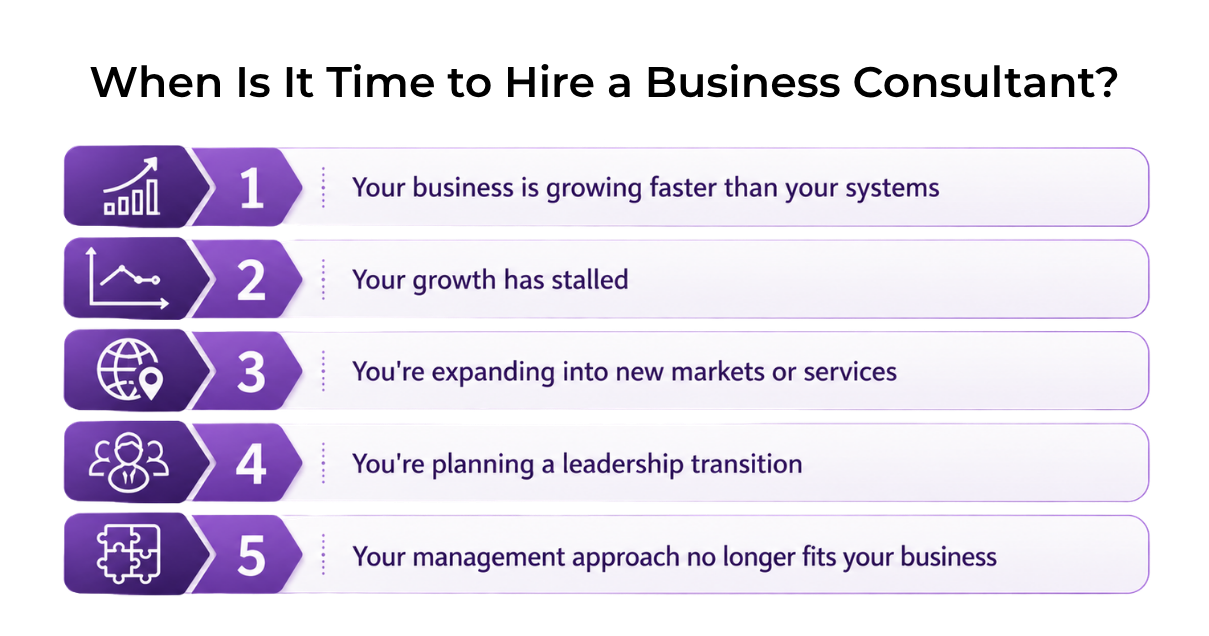
Not every business needs this, and not every stage calls for it. But there are patterns worth recognising.
You're growing faster than your systems can handle. Sales are climbing, but the back office, the team structure, or the cash flow simply can't keep pace. This is one of the most common reasons owners bring in a business growth consultant, and growth without structure tends to break something eventually, usually quality or cash, sometimes both at once.
You're stuck at a plateau nobody can explain. Revenue's been flat for a year or two despite genuine effort from the team. This is rarely a motivation issue. It's usually a positioning or strategy issue, and spotting it from the inside is genuinely difficult.
You're entering new territory. A new region, a new product line, whatever it is, the risk of getting it wrong is real and the cost of a bad move adds up fast. A consultant who's guided other businesses through similar expansions can shortcut a lot of the guesswork you'd otherwise pay for in mistakes.
There's also the succession question. Passing the business on, bringing in a partner, prepping for a sale, these involve decisions that are genuinely hard to make objectively when you're emotionally tied to the outcome.
And sometimes it's simpler: your team has outgrown your management style. What worked fine with five staff often stops working around twenty. Plenty of business consultants across New Zealand specialise in this shift, helping owners move from doing everything themselves to leading a team that can function without them in the room.
The Financial Case: Does It Actually Pay Off
Owners are right to ask whether the fees translate into real return. Consulting isn't cheap, and treating it as an impulse buy rarely goes well.
Here's a fair way to think it through. Say a business consultant costs around twelve thousand dollars over three months. If that engagement fixes a pricing problem and lifts margin by even three percent on a million dollars in annual revenue, that's thirty thousand extra dollars a year, every year, going forward. The fee pays for itself several times over, and the benefit doesn't stop when the invoice does.
Not every engagement plays out this cleanly though. The return depends on how clearly the problem was defined before work started, how much real industry experience the consultant brings, and how committed the owner actually is to implementing what gets recommended. A brilliant strategy nobody acts on is worth exactly nothing.
How to Judge Whether a Consultant Is Worth Hiring
Results vary this much because not all consultants operate the same way. A few things separate the useful ones from the expensive mistakes.
Ask for evidence, not opinions. A credible business consultant can point to real examples, ideally with actual numbers attached. Vague talk about "transforming businesses" without anything concrete behind it should raise an eyebrow.
Check whether their experience actually fits your industry. Someone who's spent years in retail may not translate well to a professional services firm. Cash flow patterns, growth levers, customer behaviour, these differ enough across sectors that generic advice tends to fall flat.
Watch how they run the process. The good ones diagnose before they prescribe. If someone jumps straight into recommendations before understanding your numbers, your team, and your customers properly, that's worth noticing.
Agree on what success looks like before the work starts. Revenue growth, margin improvement, staff retention, whatever it is, pin it down early. Without that, judging the return afterwards becomes guesswork dressed up as evaluation.
And find out who's actually doing the work. Some firms sell you a senior expert in the pitch, then quietly hand the day to day to someone junior. Know who you're working with before you commit.
Also Read: https://www.bizdom.co.nz/insights/improve-cash-flow-management-for-small-businesses-in-new-zealand
Business Consultant vs Business Coach: What's the Real Difference
This one trips a lot of people up, and it's worth untangling because the two roles genuinely serve different purposes.
Business coaching in New Zealand is based more on the individual who pulls the strings. The coach will deal with your thinking, your leadership skills, and how to make decisions when under pressure. These meetings take place weekly or fortnightly and the goal is to develop you as a leader.
A business consultant focuses on the business itself. They're brought in to solve a specific operational or strategic problem within a defined window, and they often get properly hands on, rebuilding a pricing model, restructuring a team, mapping out a growth plan, whatever the job requires.
Quite a few owners end up needing both, just not at the same time. Struggling with confidence, delegation, or burnout personally? Coaching is the better starting point. Facing a specific structural or strategic problem in the business? That's consultant territory. Some New Zealand advisory firms, ours included, offer both, because the two often work better paired together than either does alone.
What Actually Happens During the Process
If you've never worked with a business consultant before, here's roughly how a solid engagement tends to unfold.
It usually opens with a diagnostic phase. The consultant digs through your financials, talks to your team, reviews the current strategy and systems. This part alone often surfaces issues owners hadn't fully clocked, simply because someone with fresh eyes is asking better questions than the ones you've been asking yourself.
Then comes strategy. Based on what the diagnostic turned up, the consultant builds a plan with clear priorities attached. A decent one won't dump fifteen recommendations on you at once. They'll pick the two or three changes that'll move things fastest and start there.
Implementation follows, and this is really where the value gets proven or exposed. It's the phase that separates useful consulting from an expensive slide deck nobody reads twice. The consultant works alongside your team to put the plan into motion, adjusting as real results come in rather than sticking rigidly to the original document.
Finally, review. A proper engagement closes with an honest look at what changed, what worked, and what still needs attention.
Mistakes That Show Up Again and Again
A handful of patterns keep repeating in engagements that don't go well, and most are avoidable.
Hiring reactively, in a panic, without a clear brief, is the big one. When a business only calls a consultant after things have gone properly wrong, there's less time to diagnose and less room to be strategic. Better results come from businesses that bring in help while things are still going reasonably well, before growth stalls completely.
Picking on price alone is another. The cheapest business consultant isn't automatically the worst value, and the priciest one isn't automatically the best. Fit and relevant experience matter more than the number on the invoice.
Then there's handing the whole thing off. Owners who disappear from the process and expect the consultant to fix everything alone usually end up disappointed. Strong results happen when the owner stays genuinely involved while leaning on the consultant's expertise.
And stopping too early. Real change, a restructured team, entry into a new market, takes longer than a few weeks to bed in. Pull the plug the moment things feel uncomfortable and you'll likely miss the payoff sitting just around the corner.
Is It Worth It for Small and Medium Businesses Specifically
Some owners assume consulting is reserved for large corporates with deep pockets. That's outdated. Small and medium businesses often see the biggest relative gains from working with a business consultant, mostly because there's more low-hanging fruit to fix. A pricing tweak, a cleaner sales process, better financial reporting, any of these can have an outsized impact on a smaller business compared to a large one where systems are already mature.
New Zealand's business landscape suits this well. Most Kiwi businesses are small to medium sized, often owner-operated, stretched thin across too many roles at once. A business consultant New Zealand owners actually trust doesn't need corporate-scale complexity to be useful. They need practical, locally relevant advice that accounts for our market size, our regulatory environment, and the reality of running a lean team.
What Does It Cost to Hire a Business Consultant in New Zealand
It varies according to the scale, experience and level of involvement required in the process. For your reference, individual consultants and small advisory firms usually charge anywhere from 150 to 400 dollars per hour although for projects that have a known end result, the price would be quoted on a project basis. For large firms dealing with big corporations, the rates are far higher.
From the perspective of value, most small and mid-size companies can benefit more from a limited engagement based on addressing a specific issue than a retainer. It makes sense to always get a quote from a consultant based on the results expected, rather than the time involved.
Making the Actual Decision
If you're still weighing this up, a few honest questions help. Is there a specific problem costing you money or growth right now that you haven't managed to solve internally? Have you genuinely tried fixing it over the last six to twelve months without lasting success? Would getting this right add value for years beyond just this one fix?
If the answer's yes across the board, hiring a business consultant is very likely worth it. The investment isn't really in their time. It's in the speed, clarity, and outside perspective they bring to a problem you've probably been staring at for too long to see clearly on your own.
They aren't magic though, and no consultant can fix a business unwilling to change. Paired with an owner who's actually ready to act, the right one is still one of the fastest ways to turn a stuck business into a growing one.
Frequently Asked Questions
-
Most focused engagements run somewhere between six weeks and six months. A pricing or process fix might take six to eight weeks. A full growth strategy with implementation support often runs three to six months.
-
Yes, and often small businesses see the fastest return, since there's usually more room for quick wins. The trick is scoping the engagement to one well-defined problem instead of trying to fix everything at once.
-
An accountant focuses on compliance, tax, and historical reporting. A business consultant looks forward, using that data to build a plan for where the business is heading next. The two roles complement each other rather than compete.
-
If core operations or overall direction need attention, a general business consultant fits better. If the business is already healthy but you want more revenue out of what you've already got, a business growth consultant is the more targeted choice.
-
Agree on measurable outcomes before you start, revenue growth, margin improvement, a specific operational milestone, whatever applies. Review against those actual numbers at the end, not just on how the process felt while you were in it.
Finding the right fit among the many business consultants NZ businesses can choose from comes down to relevance, evidence, and a genuine willingness to get into the detail rather than hand over a report and vanish.