

Provisional Tax Due 28 August: A Kiwi Business Owner's Guide to Getting It Right
August can be a busy month for a business owner. There are wages to run, suppliers to pay, invoices to chase and, before you know it, another tax date is sitting on the calendar.
For many New Zealand businesses, 28 August is one of those dates worth paying attention to. If you have a standard 31 March balance date, your first provisional tax installment may be due on that date. Your GST return and payment may also fall around the same time.
If your business has changed since last year, that can raise another question: Does the amount I'm expecting to pay still make sense?
That's worth checking before the due date. Here's what you need to know about Provisional Tax NZ and what to look at before 28 August.
What Is Provisional Tax?
Provisional tax is a way of paying income tax during the year rather than waiting until the end of the tax year and receiving a single larger tax bill.
You will generally need to pay provisional tax if your residual income tax (RIT) from the previous tax year is more than $5,000. RIT is broadly the amount of income tax left to pay after taking into account PAYE and other applicable tax credits.
There are different rules for new provisional taxpayers and businesses whose circumstances have changed, so the $5,000 threshold shouldn't be treated as a universal rule for every business.
The simplest way to think about provisional tax is this: you're paying towards your income tax as you go, rather than trying to find the whole amount at the end of the year.
Why Is 28 August Important?
For a taxpayer with a standard 31 March balance date, 28 August 2026 is generally the first provisional tax installment if you're using the standard, estimation or ratio option. AIM installments can also be due on 28 August for March balance-date taxpayers.
But 28 August isn't the provisional tax deadline for every New Zealand business.
Your payment dates may depend on your balance date and the payment method you use. Businesses with a non-standard balance date, for example, can have different installment dates. GST filing arrangements can also affect the number and timing of provisional tax payments.
So before assuming you need to make a payment on 28 August, check your myIR account or confirm the date with your accountant.
Getting the date right is the easy part. The more important question is whether the amount you're paying still reflects your business's current position.
How Is Provisional Tax Calculated?
There are four main ways to work out provisional tax:
Standard option
Estimation option
Ratio option
Accounting Income Method (AIM)
The standard option generally uses your previous year's residual income tax plus a 5% uplift. However, if your previous year's tax return hasn't been filed by the relevant provisional tax date, the calculation can instead use your RIT from two years ago plus a 10% uplift for certain installments.
The estimation option is different. You estimate what your current year's residual income tax is likely to be and use that figure for your provisional tax. This can be useful when your income has changed significantly from the previous year. The estimate needs to be realistic, though. Underestimating your tax can leave you with additional costs.
The ratio option calculates provisional tax using a percentage based on your previous RIT and GST taxable supplies. It's available only to eligible GST-registered businesses and can be useful where income varies from one period to another.
Then there's AIM, which uses accounting information and cash flow during the year to calculate provisional tax installments. It can suit some businesses with seasonal or unpredictable income.
There isn't one method that's right for every business. The way your income comes in, how predictable your profits are, and how your cash flow behaves can all matter.
What If Your Business Income Has Changed?
This is where it pays to look beyond last year's tax bill.
Say your business had a particularly strong year, but sales have slowed in 2026. If you simply repeat last year's provisional tax calculation, you could end up paying based on a level of profit you're no longer expecting.
The opposite is just as important.
Perhaps you've taken on several new clients, increased your prices, or expanded the business. Revenue is higher, and profit looks stronger than it did last year. In that situation, relying on an old tax figure could leave you with a larger bill later.
Before changing your provisional tax estimate, look at what's actually happening in the business. Review your revenue so far, expenses, expected profit, and any changes that could affect the rest of the year.
Not every short-term change means your tax position needs to be recalculated. A temporary dip in sales is different from a sustained change in profitability.
If you do choose to estimate your provisional tax, don't base the estimate simply on what you can afford to pay. It should reflect a reasonable view of your expected tax position. IRD notes that interest can apply where provisional tax is underpaid.
Provisional Tax and Your GST Return NZ: Are They the Same Thing?
No. They're separate tax obligations, although the timing can make them feel like one.
Your GST return NZ obligations relate to GST you've collected from customers and GST you can claim on eligible business purchases during the relevant taxable period.
Provisional tax is different. It relates to your income tax.
The confusion usually comes from the calendar. For some March balance-date businesses, GST and provisional tax payments can both fall around 28 August. IRD's current calendar confirms that a GST return and payment for the taxable period ending 31 July is due on 28 August, alongside provisional tax for eligible March balance-date taxpayers.
So when you're working out what needs to leave the business bank account in August, look at the GST and provisional tax figures separately. It makes the total easier to understand and, just as importantly, easier to plan for.
What Happens If You Cannot Afford Your Provisional Tax Payment?
This is one of those problems that's much easier to deal with before the due date. If the amount due is higher than you expected and the money isn't in the bank, start by reviewing your cash flow. What money is coming in? What needs to be paid? Is the shortfall temporary, or is it likely to continue?
Then talk to your accountant or IRD.
Payment arrangements may be available in some circumstances if you can't pay the full amount. They aren't automatic, so it's better to discuss the situation rather than simply let the payment become overdue.
Tax pooling may also be worth discussing with your accountant. It can help with certain tax-payment situations, but it has specific rules and won't necessarily be appropriate for every business.
The important thing is to act early.
Common Provisional Tax Mistakes Business Owners Make
Most provisional tax mistakes aren't particularly complicated. They're usually what happens when tax gets pushed down the to-do list during a busy period.
A few common ones are:
Leaving it until 28 August: If the numbers don't look right, there's little time left to investigate them.
Automatically repeating last year's amount: Your business may look very different this year.
Ignoring changes in profitability: A significant increase or decrease in profit can change your tax position.
Confusing GST with income tax: They're separate liabilities, even when they're due around the same time.
Forgetting about cash flow: A tax bill may look manageable on paper but be difficult to pay if the money hasn't been set aside.
Using the wrong payment date: Your balance date and provisional tax method can affect when payment is due.
Late or underpaid provisional tax can also lead to penalties and, depending on the circumstances, interest.
A Simple Checklist Before 28 August
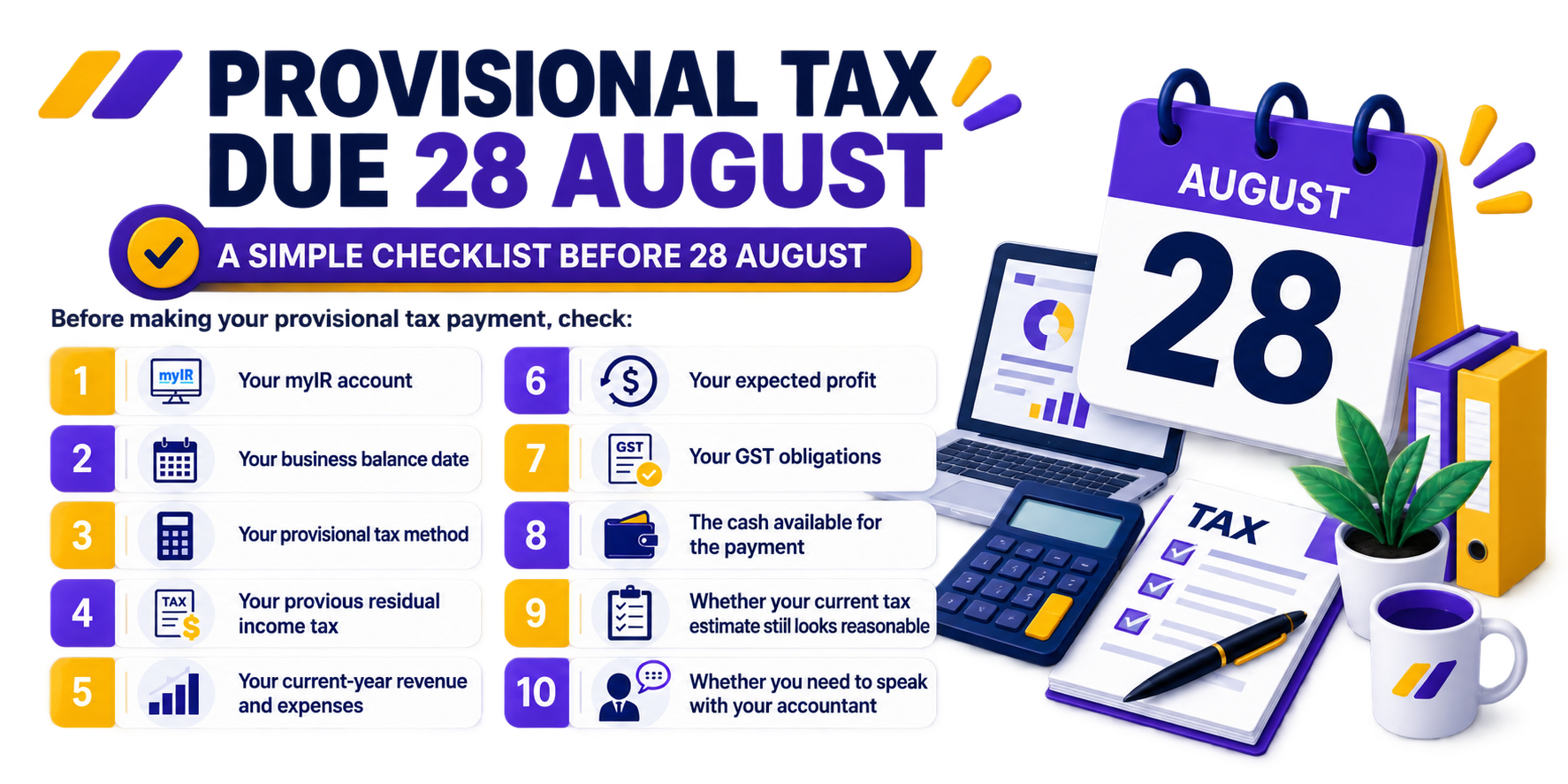
Before making your provisional tax payment, check:
Your myIR account
Your business balance date
Your provisional tax method
Your previous residual income tax
Your current-year revenue and expenses
Your expected profit
Your GST obligations
The cash available for the payment
Whether your current tax estimate still looks reasonable
Whether you need to speak with your accountant
If your business looks substantially different from last year, don't just assume the same approach still makes sense.
When Should You Speak to a Chartered Accountant NZ?
You don't necessarily need professional advice every time you make a tax payment. But there are situations where a second set of eyes can be useful.
Perhaps the business has grown quickly. Maybe profit has dropped unexpectedly, cash flow is tight, or you've changed your business structure. You may also be unsure whether the provisional tax method you're using still suits the way your business operates.
This is where a Chartered Accountant NZ can offer more than simply working out a tax figure. They can help you understand what's driving the numbers and how the tax payment fits into the business's broader financial position.
For Hawke's Bay businesses, this can also be part of broader business advisory support in the region. Tax, cash flow, and business decisions are often interconnected, particularly when a business is growing or undergoing change.
Bizdom works with New Zealand business owners across accounting, tax compliance and business advisory, helping them understand their numbers and plan ahead.
Final Takeaway
28 August doesn't need to become a last-minute tax scramble. Before the date arrives, check that you have the right payment date, understand which provisional tax method you're using, and take a realistic look at how your business is performing this year.
If your numbers have changed significantly, don't automatically assume last year's tax position is still the right guide. For a business owner, provisional tax is more than another payment on the calendar. It is part of managing cash flow and knowing what your business needs to set aside for tax.
And if you're unsure about the numbers, it's better to have that conversation before the due date than after. For Hawke's Bay business owners, Bizdom can help you work through your provisional tax position and understand how it fits with the wider financial picture.
-
Provisional tax is income tax paid during the year rather than waiting until the end of the tax year. It helps spread income tax payments across the year.
-
For a standard 31 March balance date, the usual standard or estimation installments for the 2027 provisional tax year are due on 28 August 2026, 15 January 2027 and 7 May 2027. Other balance dates and methods can have different dates.
-
For March balance-date taxpayers, provisional tax is generally due on 28 August when using the standard, estimation, or ratio options. AIM installments can also be due on this date. Check myIR to confirm the payment date that applies to you.
-
There's no single amount that applies to every business. It depends on your provisional tax method, previous tax position and, where applicable, your estimate of current-year income. Under the standard option, the calculation generally uses the previous year's RIT plus the applicable uplift.
-
The four main methods are the standard, estimation, ratio and AIM options. Each works differently, so the method you use can affect both the amount and timing of your provisional tax payments.
-
If the estimation option applies to your circumstances, you can estimate your current-year residual income tax rather than relying on the standard calculation. The estimate should be based on a realistic view of your expected tax position.
-
Don't simply leave the payment unpaid. Contact IRD or speak with your accountant as soon as possible. Payment arrangements may be available depending on your circumstances.